
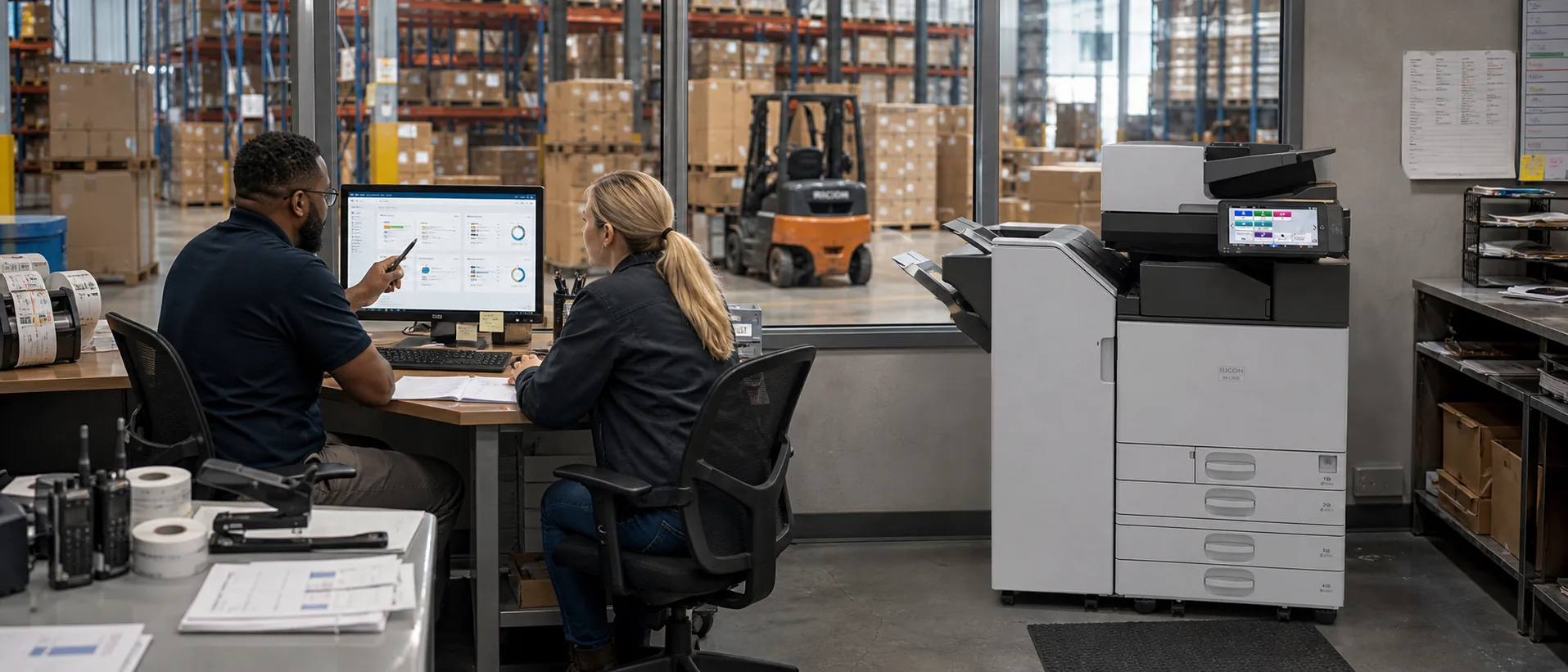
What are managed print services?
Managed print services, often shortened to MPS, are an outsourced program for assessing, supporting and improving a business’s printers, copiers and document workflows. A managed print services provider may inventory the fleet, monitor meters and toner levels, coordinate supplies, dispatch service, standardize devices, report costs, apply security policies and recommend changes as actual usage develops.
Strengthen the assessment with guidance on copier service-contract coverage, copier cost per page, office copier security features and copier lifespan. The current copier FAQ library adds focused managed-print answers.
What managed print services include
A strong managed print services agreement begins with evidence rather than a predetermined equipment sale. The provider should understand which devices exist, where they are located, who depends on them, how many black-and-white and color pages they produce, what service problems recur and which workflows are genuinely business-critical.
Print fleet assessment
Inventory devices, locations, meters, age, service history, supplies and user requirements.
Managed Print Fleet Design
Right-size equipment, reduce unnecessary variation and define reliable placement.
Managed Print Service and Supplies
Monitor supplies, coordinate copier repair, maintain devices and report performance.
Managed Print Cost Reviews
Compare results with the baseline and adjust as offices, teams and workflows change.
Common managed print services components
- Printer and copier fleet inventory
- Remote meter and supply-level monitoring
- Automatic toner replenishment
- Preventive maintenance and copier repair coordination
- Black-and-white and color usage reporting
- Device standardization and lifecycle planning
- Print policy, user authentication and secure release options
- Multi-location service management and escalation
- Quarterly or scheduled business reviews
Managed print services vs a copier service agreement
A copier service agreement normally covers a defined machine or group of machines. It may include toner, parts, labor and a black-and-white or color cost per page. Managed print services operate at the fleet level and add assessment, monitoring, reporting, policy and continuous optimization.
| Service model | What it usually covers | Best fit |
|---|---|---|
| Break-fix printer service | Repair after a failure; supplies and monitoring are normally separate. | Very small fleets with low print dependency. |
| Copier maintenance contract | Specified equipment, toner, parts, labor and per-page billing. | A small number of known commercial copiers. |
| Managed print services | Fleet assessment, monitoring, supplies, service, reporting, optimization and governance. | Mixed fleets, multiple locations, material IT burden or limited cost visibility. |
Organizations replacing only one machine can start with current office copier prices. Organizations managing many devices should compare those quotes with a complete managed print assessment.
Benefits of managed print services for businesses
The most valuable managed print services benefits come from controlling the whole environment. Replacing devices without a baseline may simply preserve excessive color use, stranded toner, inconsistent service and more printers than the business needs.
Why businesses use managed print services
IT teams use MPS to reduce time spent tracking toner and coordinating printer repair. Procurement teams use managed print reporting to compare devices, providers and contract performance. Finance teams gain a clearer view of recurring print costs. Operations leaders gain a structured method for supporting offices where printing, scanning and copying affect daily work.
Healthcare offices, law firms, schools, manufacturers, nonprofits, construction companies and distributed professional-services teams may all benefit, but for different reasons. A medical practice may emphasize secure document release and uptime; a school district may focus on device placement and page reporting; a construction company may need consistent service across permanent offices and project sites.
Managed print services for small business
Managed print services for small business do not need to imitate an enterprise program. A smaller office may need only meter collection, automatic toner, service dispatch and a scheduled review of actual device use. The provider should scale the program to the fleet rather than adding software and reporting the business will not use.
Small businesses with one primary copier should compare MPS with a straightforward service agreement and a correctly sized machine. Use the monthly copier volume guide and the copier lease vs buy guide before accepting a fleet-wide proposal.
Compare Managed Print Services Prices
Start with device count, locations, monthly volume and the support problems you need to solve.
Managed print services pricing and contract models
Managed print services pricing can be structured as cost per page, a monthly base with included pages, a device-level service charge, a bundled equipment-and-service payment or a customized fleet agreement. The lowest quoted rate is not necessarily the lowest expected cost if it includes unrealistic minimums or excludes important devices and support.
What changes managed print services cost?
- Number, age, brand and location of devices
- Monthly black-and-white and color volume
- Coverage hours and response requirements
- Toner, parts and labor inclusions
- Onsite staffing or dedicated support requirements
- Monitoring, reporting and security software
- Device replacement, lease or purchase obligations
- Travel and service coverage for remote locations
Questions to ask about managed print services pricing
- What is the baseline?Require device counts, meter data and current cost assumptions.
- Which devices are covered?List every copier and printer by model, serial number and location.
- How are pages counted?Separate black-and-white, color, large-format and special page rules.
- What is excluded?Clarify paper, staples, drums, specialty supplies, network work and after-hours service.
- How do rates change?Review annual increases, minimums, added devices and reduced volume.
What happens during a print fleet assessment?
A print fleet assessment should combine data with observation. Meter data shows volume, but a walkthrough can reveal abandoned equipment, unopened toner, inconvenient placement, confidential output left unattended or workflows that force employees to print and rescan documents.
The assessment should identify each device, network connection, department, monthly volume, color mix, peak demand, service record and business purpose. The recommendation should then explain which devices stay, move, consolidate, replace or retire—and what effect each change has on users.
Ricoh describes an enterprise case study that began with an in-depth fleet assessment and device-level tracking before equipment and workflow changes were made. The principle applies to smaller environments too: measure first, then redesign. See the Ricoh managed print case study.
Managed print security and networked copier risk
Printers and multifunction copiers are network-connected endpoints that may process, transmit or store sensitive documents. NIST specifically uses an office printer as an example when discussing cybersecurity and privacy risks created by connected devices. A managed print provider should coordinate with IT rather than treating copier security as a one-time installation setting. Review the NIST connected-device guidance.
Managed print security controls to compare
- Firmware and security update process
- Default-password replacement and administrator access
- Port, protocol and network-service configuration
- Secure print release with PIN or badge authentication
- Address-book and scan-destination controls
- Stored-data encryption and overwrite options where supported
- Device retirement, storage removal and documented disposition
- Security reporting and exception remediation
HP’s current managed print materials include print-security assessment, planning and deployment as service elements. That is a useful evaluation principle across providers: ask who owns the assessment, who applies changes and how the fleet is checked afterward. See HP Managed Print Services.
Managed print services and sustainability
MPS can support sustainability when it measures the fleet, reduces unnecessary devices, keeps duplex and sleep settings active and reports usage trends. It should not rely on vague environmental claims. ENERGY STAR’s imaging-equipment guidance notes that certified printers and copiers include efficiency, power-management and duplexing requirements. See the ENERGY STAR imaging equipment guide.
Useful managed print sustainability metrics include device count, black-and-white and color volume, duplex rate, energy settings, paper consumption and retired-equipment disposition. The provider should show the baseline and the reporting method.
How to choose a managed print services provider
A managed print services company should be evaluated as an operating partner, not only an equipment source. Ask how the provider measures the current environment, staffs local service, monitors devices, protects collected telemetry, handles supplies, reports performance and changes the fleet when business needs shift.
| Evaluation area | Evidence to request |
|---|---|
| Assessment quality | Device inventory, meter history, location map, user interviews and documented assumptions. |
| Service operation | Dispatch process, coverage map, response targets, escalation contacts and parts strategy. |
| Supply fulfillment | Meter trigger, shipping process, emergency toner procedure and excess-supply controls. |
| Security and data handling | Monitoring architecture, collected fields, access controls, retention and device-hardening process. |
| Reporting | Sample dashboard, device-level costs, uptime, service trends, color use and review cadence. |
| Contract flexibility | Device additions/removals, volume changes, annual increases, renewal and termination language. |
Compare current copier manufacturers, office copier pricing and local support through the copier dealer directory. The right managed print proposal should make those elements easier to evaluate, not hide them inside one monthly figure.
Managed print services implementation steps
- Confirm the baseline and scope.Approve the inventory, current volume, covered locations and business objectives.
- Document the future fleet.List retained, moved, replaced and retired devices with reasons.
- Plan transition and communication.Schedule installation, network work, user training, toner cleanup and service handoff.
- Apply monitoring and security settings.Coordinate credentials, telemetry, firmware, access and secure-print policies with IT.
- Measure performance.Review service, supplies, uptime, volume, cost and user issues against the starting point.
Questions businesses ask about managed print services
What is included in managed print services?
Typical programs include fleet assessment, meter and toner monitoring, automatic supplies, service coordination, reporting and ongoing equipment optimization. Security and workflow services vary by provider and contract.
How are managed print services priced?
Pricing may use cost per page, a monthly base with included volume, device-level charges or a bundled fleet payment. Compare minimums, annual increases, covered equipment and exclusions.
Can managed print services cover different printer brands?
Many providers support mixed fleets, but coverage, parts access and monitoring depth can vary by brand and model. Require a device-by-device coverage list.
Are managed print services only for large companies?
No. Small businesses can use a scaled program for toner, meters, service and basic reporting. The administrative value should justify the contract complexity.
Does managed print include new copiers?
It can, but equipment financing and managed services should be clearly separated in the proposal. A provider may retain existing devices, replace selected units or finance a new standardized fleet.
How long does managed print implementation take?
Timing depends on fleet size, locations, network requirements and equipment changes. A responsible proposal provides a phased transition plan rather than a generic date.